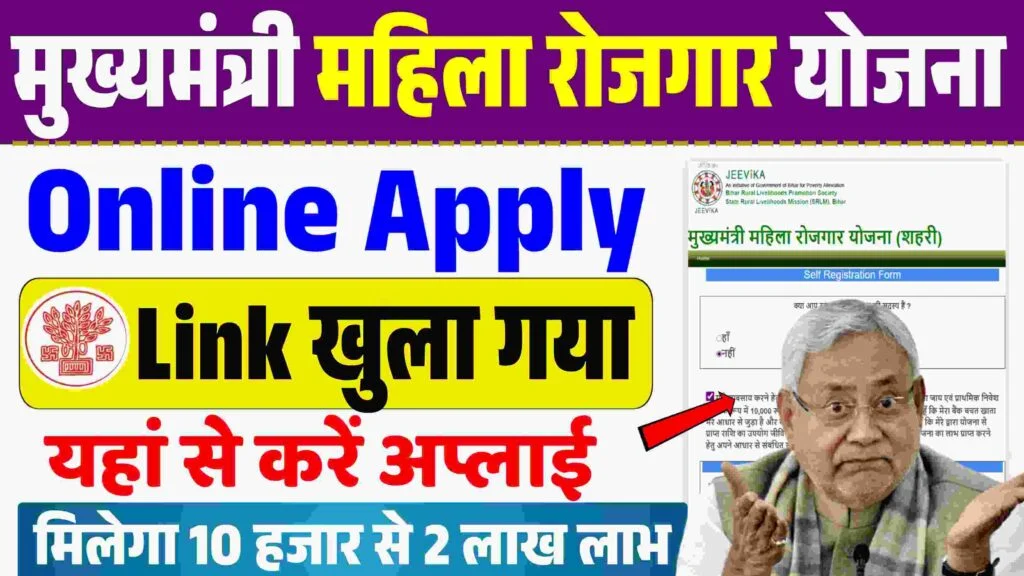
The development of any society is measured not only by its economic progress but also by the level of participation of women in shaping that progress. Women’s empowerment has, therefore, emerged as a central theme in public policy across India. In Bihar, where poverty and unemployment have historically posed challenges, providing sustainable livelihood opportunities to women becomes both a social and an economic necessity.
To address this, the Government of Bihar has launched the Chief Minister Mahila Rojgar Yojana. The programme is designed to extend financial assistance and institutional support to women so that they can establish income-generating activities of their choice. By encouraging at least one woman from every family to become self-reliant, the scheme seeks to transform households, communities, and eventually the economy of the state.
Need for the Scheme
Bihar has a large rural population, and women in the state often face restricted access to resources, skill training, and financial support. Even though women’s self-help groups (SHGs) under the Jeevika project have achieved significant progress in mobilising rural women, lack of adequate capital has been a persistent barrier.
The Chief Minister Mahila Rojgar Yojana fills this gap by providing initial seed money, followed by additional financial assistance if the enterprise shows promise. The scheme, therefore, combines financial inclusion with entrepreneurship development, ensuring that women are not left behind in the state’s economic growth.
Objectives of the Scheme
The programme has been launched with multiple goals:
- Encouraging Women’s Employment – Helping women start small businesses or enterprises of their choice.
- Household Empowerment – Ensuring at least one woman per family gains financial independence.
- Strengthening SHGs – Linking beneficiaries with self-help groups for collective support and monitoring.
- Balanced Implementation – Rural areas are covered through the Rural Development Department and Jeevika, while urban areas are supported by the Urban Development and Housing Department.
- Boosting the State’s Economy – Creating a wide base of micro-enterprises run by women, thereby increasing household incomes and contributing to local economic activity.
Key Features of the Scheme
- Seed Assistance: Each eligible woman receives ₹10,000 as the first instalment to begin employment.
- Further Financial Help: After assessing the business requirement and progress, an additional amount of up to ₹2 lakh can be sanctioned.
- Training Provision: Women must undergo training to ensure that financial assistance is utilised effectively.
- Urban and Rural Convergence: While Jeevika implements the scheme in villages, the Urban Development Department coordinates with urban SHGs to cover cities and towns.
- Grievance Mechanism: If anyone demands money for application or benefits, women can complain at Jeevika district offices or municipal offices.
Eligibility Conditions
To make sure that the benefits reach the right households, the state has defined strict eligibility rules:
- Definition of Family: Husband, wife, and their unmarried children. For an unmarried adult woman without parents, she is considered a separate family.
- Age Limit: Applicant must be between 18 and 60 years.
- Exclusion Clauses: Neither the woman nor her husband should be an income tax payer. Neither should be employed in government service, whether permanent or contractual.
- Self-Help Group Membership:
- Rural women must be members of Jeevika self-help groups.
- Urban women must also be part of SHGs; if not, they need to join before receiving benefits.
This ensures that support reaches genuinely needy households and prevents duplication of benefits.
Application Process
A. For Women in Urban Areas
- Digital Application: Women from towns and cities can apply online by filling out a form with details such as mobile number, Aadhaar number, bank account information, and type of business.
- Document Upload: Scanned copies of Aadhaar card, bank passbook, photograph, and signature on a plain page must be uploaded.
- Self-Help Group Membership: Women not yet associated with an SHG will be guided by a community worker to join one. Only after joining can they avail benefits.
- Verification: Physical checks are carried out to ensure the applicant is a resident of Bihar and meets all conditions.
- Training Requirement: Before receiving financial assistance, women must undergo training sessions.
Women already linked with SHGs in urban areas do not need to reapply online.
B. For Women in Rural Areas
- Through Village Organisations: Members of Jeevika SHGs can apply via their village organisations. Consolidated applications are taken during special meetings at the village organisation level.
- For Non-Members: Women who are not yet part of Jeevika must first apply to join an SHG at the village organisation. Once accepted, they can submit applications for scheme benefits.
Implementation Strategy
- Rural Implementation: Carried out through the Rural Development Department and Jeevika, which has a strong presence in Bihar’s villages.
- Urban Implementation: Supported by the Urban Development and Housing Department, ensuring women in towns also benefit.
- Financial Transfers: All monetary assistance is directly credited to the beneficiary’s bank account using digital transfer methods.
- Monitoring: Community workers and Jeevika functionaries ensure that the funds are used for the intended employment activities.
This structure ensures transparency, community involvement, and accountability at every step.
Expected Impact of the Scheme
1. Strengthening Women’s Agency
By providing direct financial assistance, women will gain confidence and decision-making power within their households and communities.
2. Self-Employment Opportunities
Small ventures like tailoring, dairy farming, food processing, petty shops, or service-based businesses will be created, generating income for thousands of families.
3. Consolidation of SHGs
Mandatory SHG membership ensures more women become part of collective institutions that offer mutual support and financial discipline.
4. Inclusive Development
Special provisions for unmarried women without parental support guarantee that vulnerable groups are not excluded.
5. Local Economic Growth
Women-run enterprises will boost local markets, create employment opportunities, and add to Bihar’s economy.
Challenges Ahead
- Awareness Gaps: Many women in remote areas may not know about the scheme.
- Capacity Building: Training must be practical and tailored to local business needs.
- Risk of Misuse: Without strict monitoring, funds could be used for non-productive purposes.
- Market Linkages: Enterprises will need proper access to markets to remain sustainable.
- Urban Adaptation: Organising women into SHGs in cities may take time and effort.
Suggestions for Improvement
- Extensive Awareness Campaigns through panchayats, municipal bodies, and local media.
- Skill Mapping to identify local economic opportunities and align women’s businesses accordingly.
- Market Integration by linking women’s products to state-level fairs, digital platforms, and cooperatives.
- Extended Handholding Support through Jeevika and NGOs for 2–3 years after the initial business launch.
- Real-Time Monitoring Dashboard at the state level for transparency and progress tracking.
- Credit Linkages with Banks to provide women with access to larger loans once they have demonstrated success.
Illustrative Cases
- Rekha from Madhubani used the initial support to start a tailoring shop, later expanding it with additional financial assistance and employing two other women.
- Shazia from Patna began a food stall that now supports her children’s education and has become a popular spot in her neighbourhood.
- Poonam from Nalanda, an orphan considered a single family unit, started a small beauty parlour and now earns enough to live independently.
Such examples highlight the scheme’s potential to change lives and communities.