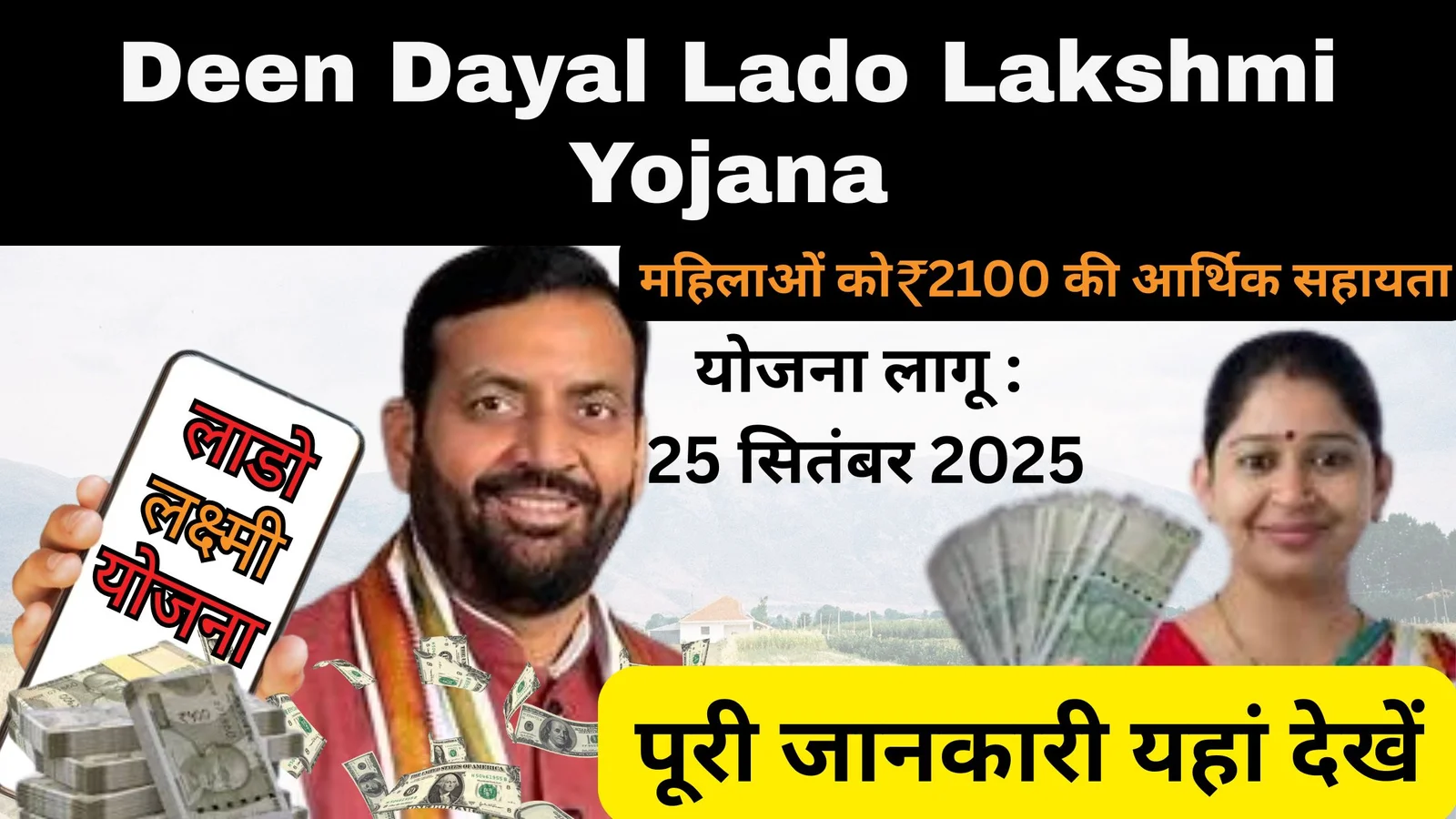
The Government of Haryana has announced a landmark welfare initiative, the Deen Dayal Lado Lakshmi Yojana (DDLLY), 2025, aimed at promoting financial independence and social security for women across the state. This scheme reflects the state’s commitment to women’s empowerment by providing financial support to enhance their quality of life, promote societal participation, and encourage self-reliance. Under this scheme, eligible women in Haryana will receive a monthly financial benefit, ensuring economic security and facilitating overall well-being. The scheme is a significant step toward bridging gender disparities and supporting women from economically weaker sections.
The scheme was officially notified on 15th September 2025, and it will come into operation from 25th September 2025. The program is applicable throughout the state of Haryana and is managed by the Social Justice, Empowerment, Welfare of Scheduled Castes and Backward Classes, and Antyodaya (SEWA) Department.
Objectives of the Deen Dayal Lado Lakshmi Yojana
The Deen Dayal Lado Lakshmi Yojana has been introduced with clear objectives focusing on the holistic empowerment of women:
- Promote Women Empowerment: To enhance the financial independence of women and provide them with a platform to actively participate in society.
- Provide Social Security: To offer a stable financial source for women, enabling them to meet day-to-day expenses and address emergencies.
- Support Economic Well-Being: To improve the standard of living of women belonging to economically weaker families.
- Encourage Societal Participation: By ensuring economic stability, the scheme empowers women to take part in educational, social, and professional activities.
The DDLLY aligns with broader national goals of gender equality and women’s welfare, ensuring that financial benefits are extended to those who need them the most.
Key Features of the Scheme
The Deen Dayal Lado Lakshmi Yojana comes with a set of features designed to ensure transparency, efficiency, and convenience:
- Financial Assistance: Every eligible woman receives a monthly financial benefit of ₹2,100, unless she voluntarily opts for a lesser amount.
- Direct Benefit Transfer (DBT): The scheme operates via Direct Benefit Transfer through the Public Finance Management System (PFMS), ensuring timely and secure disbursal to beneficiaries’ bank accounts.
- Wide Coverage: The scheme is applicable across Haryana, with no restriction on the number of eligible women in a family availing the benefit.
- Digital Implementation: Applications are submitted through the Lado Lakshmi App, developed by HARTRON, which facilitates end-to-end management including beneficiary identification, verification, grievance redressal, and monitoring.
- Eligibility Verification: The Centralized Resident Identification Database (CRID) verifies applicant details within fifteen days to ensure authenticity.
- Monthly Liveness Verification: Beneficiaries are required to complete a monthly facial authentication through the Lado Lakshmi App to ensure uninterrupted benefit disbursal.
- Automatic Transition: Upon reaching the criteria for other financial assistance schemes, beneficiaries may be automatically transitioned to relevant programs like the Old Age Financial Assistance Scheme.
Scholarship / Financial Assistance Amount
Under DDLLY, the monthly financial benefit is ₹2,100 for each eligible woman. Beneficiaries can choose a lesser amount if they prefer. This financial support is aimed at providing a basic income security layer, enabling women to meet essential needs, support education for children, or invest in small business initiatives for personal and family development.
Eligibility Criteria
To qualify for the Deen Dayal Lado Lakshmi Yojana, applicants must meet the following conditions:
- Gender: The applicant must be a woman.
- Age: She should be 23 years or older at the time of application.
- Residency: The applicant, or her husband in the case of married women from other states, must be a resident of Haryana for at least 15 years.
- Family Income: The annual family income, verified through the Family Information Database Repository (FIDR), must not exceed ₹1 lakh.
- Bank Account: Beneficiaries must have an active bank account in their name to receive the financial benefit via DBT.
Exclusion Criteria
Certain categories of women are not eligible for DDLLY:
- Women already receiving financial assistance under schemes such as:
- Old Age Samman Allowance
- Financial Assistance to Widows and Destitute Women
- Haryana Divyang Financial Assistance Rules, 2025
- Ladli Social Security Allowance
- Monetary Support for Female and Girl Survivors of Acid Attacks
- Financial Assistance for Stage III/IV Cancer patients, rare diseases, Thalassemia, Haemophilia, Sickle Cell Anemia are exceptions, and the benefit may be availed in addition to DDLLY.
- Women receiving annuity or financial assistance from government organizations, statutory bodies, or local authorities.
- Government employees or contractual workers with family income above the prescribed limit.
- Income tax payees.
This ensures that the scheme targets economically vulnerable women, providing them with financial security without duplication of benefits.
Application Process (Step by Step)
The application for DDLLY is fully digital via the Lado Lakshmi App, providing transparency and efficiency.
Step 1: Download and Registration
- Download the Lado Lakshmi App on Android or iPhone.
- Create an account and fill in personal and family details, including:
- Aadhaar details of the applicant and family members
- Residence certificate
- Income certificate
- HKRN ID (Household Registration Number)
- Electricity connection details
- Vehicle ownership details
- Bank account information
Step 2: Application Submission
- Complete the application form and submit it.
- Receive a Registration ID for future tracking.
Step 3: Verification by CRID
- CRID verifies submitted data against the existing PPP database within 15 days.
- A list of eligible and ineligible beneficiaries is generated.
Step 4: Confirmation and Choice of Benefit
- Eligible beneficiaries are notified via SMS and requested to select the benefit amount (full ₹2,100 or lesser) through the app.
Step 5: Issuance of DDLLY ID
- SEWA Department generates a DDLLY ID for each verified beneficiary within two working days.
- Bank account details are validated via PFMS, and the financial assistance is processed for disbursement.
Step 6: Monthly Liveness Verification
- Beneficiaries must complete facial authentication every month to continue receiving the financial benefit.
Step 7: Handling Payment Failures
- In case of payment failure due to invalid bank details, beneficiaries are notified and can update details through the app.
- Financial assistance is paused if disbursal fails consecutively for two months and resumed once corrections are verified.
Reservation Policy
The Deen Dayal Lado Lakshmi Yojana does not restrict the number of eligible women per family. Any woman meeting the eligibility criteria can avail herself of the benefits irrespective of her family composition. The scheme is designed to focus on economic criteria rather than caste or category, although it falls under the SEWA department which primarily deals with socially and economically backward sections.
Distribution of Benefits
The scheme ensures direct transfer of benefits through the PFMS system, avoiding middlemen and ensuring timely receipt of funds. The process includes:
- Verification: CRID verifies eligibility and sends the final list to the SEWA Department.
- DDLLY ID Generation: SEWA Department issues a unique ID for each eligible woman.
- Bank Account Validation: Bank details are validated via PFMS.
- Disbursal: Funds are credited monthly to the beneficiary’s account.
- Monitoring: Continuous monitoring via the Lado Lakshmi App ensures smooth operation.
Renewal and Continuation Policy
The scheme continues automatically for eligible women as long as they meet the criteria of age, residency, and income. Monthly facial authentication ensures beneficiaries remain eligible and actively part of the program.
In cases where a beneficiary becomes eligible for other government schemes (e.g., Old Age Financial Assistance, Widows and Destitute Women Scheme), she may be transitioned automatically to the relevant scheme without interruption in benefits.
Withdrawal / Stoppage of Assistance
Financial assistance under DDLLY will be stopped immediately in the following situations:
- If the beneficiary violates eligibility criteria.
- If it is found that the financial assistance was granted based on false or incomplete information.
- If the beneficiary receives any other government financial assistance exceeding the limits.
- Upon the death of the beneficiary, with payment made for the full month in which death occurs.
These measures ensure transparency and accountability in the disbursal process.
Grievance Redressal Mechanism
The scheme has a dedicated grievance redressal mechanism to address issues promptly:
- Through Lado Lakshmi App: Beneficiaries can submit complaints under relevant categories.
- District Social Welfare Officer (DSWO): First-level resolution within seven working days.
- Escalation: If unresolved, grievances are escalated to the Additional Deputy Commissioner (ADC), and finally to the Deputy Commissioner (DC).
This ensures that any discrepancies or concerns are addressed efficiently and transparently, maintaining the credibility of the scheme.
Institutional Framework
The DDLLY is managed through a robust institutional framework to ensure effective implementation:
Governing Body: Chaired by the Chief Minister and meets quarterly.
- Chief Minister (Chairperson)
- Minister, SEWA (Member)
- Chief Secretary (Member)
- ACS, Finance Department (Member)
- ACS, SEWA Department (Member Secretary)
- ACS, CRID (Member)
- ACS/PS/C&S, DIPR (Member)
- 5 Public representatives nominated by CM (Members)
Executive Body: Chaired by Chief Secretary, meets monthly.
- Chief Secretary (Chairperson)
- ACS, Finance Department (Member)
- ACS, SEWA Department (Member)
- ACS, CRID (Member)
- Managing Director, HARTRON (Member)
- Director, SEWA Department (Member Secretary)
This dual-level oversight ensures policy-level guidance and day-to-day operational monitoring.