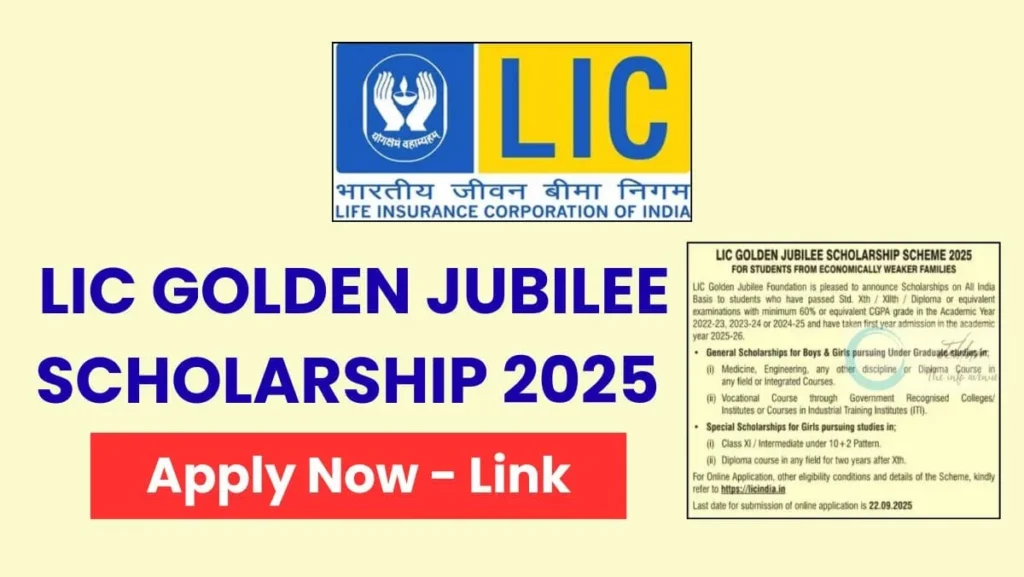
Education is not merely a pathway to knowledge; it is a means to empowerment, social mobility, and economic progress. In India, however, access to higher education and skill-based training is often constrained by financial limitations, especially for students belonging to economically weaker sections (EWS). Recognising this challenge, the Life Insurance Corporation of India (LIC), through its social responsibility arm – the LIC Golden Jubilee Foundation (LIC GJF) – has been implementing the Golden Jubilee Scholarship Scheme.
The year 2025 marks the continuation of this important initiative, reaffirming LIC’s commitment to ensuring that meritorious students from underprivileged backgrounds receive support for pursuing higher studies. The scheme not only covers conventional higher education like medicine, engineering, and graduation courses but also extends to vocational training, industrial training institutes (ITIs), and even provides a special category for girls.
This article presents a detailed analysis of the Golden Jubilee Scholarship Scheme 2025, highlighting its objectives, eligibility, benefits, implementation process, and its broader implications for equity in education.
Background of the Scheme
The LIC Golden Jubilee Foundation (GJF) was established in 2006, coinciding with the completion of 50 years of LIC’s service to the nation. Since its inception, the Foundation has been undertaking a range of social welfare projects in education, health, and livelihood. Among these, the Golden Jubilee Scholarship Scheme has emerged as one of the flagship programmes, directly targeting the educational aspirations of disadvantaged students.
The scheme has undergone refinements over the years to widen its reach, improve transparency, and align with the evolving educational needs of society. By 2025, the programme has become one of the most well-known scholarship initiatives outside the government framework, benefitting thousands of students annually.
Objectives of the Scheme
The primary objective of the Golden Jubilee Scholarship Scheme 2025 is:
- To provide financial assistance to meritorious students belonging to the economically weaker sections (EWS) of society.
- To promote access to higher education in fields such as medicine, engineering, graduation in various disciplines, integrated courses, and vocational training.
- To enhance employability of young students by supporting technical and skill-based education.
- To encourage girl education through a specially designed scholarship for female students after Class X.
- To reduce dropout rates at the crucial transition stage from school to college or vocational training.
The scheme thus blends social equity with human capital development, ensuring that financial hardship does not obstruct the academic journey of talented youth.
Scope of the Scheme
The Golden Jubilee Scholarship Scheme 2025 covers:
- Students studying in India only.
- Higher education in Government and Private colleges/universities.
- Technical and vocational courses in Industrial Training Institutes (ITIs) and Industrial Training Centres affiliated with the National Council for Vocational Training (NCVT).
- Integrated courses after Class XII.
- Two categories of scholarships:
- General Scholarship (for boys and girls).
- Special Scholarship for Girls (post-Class X).
The scope is deliberately broad, acknowledging that higher education is not limited to traditional degrees alone but also includes skill-oriented pathways crucial for employability in today’s economy.
Eligibility Criteria
A. General Scholarship
- After Class XII (or Diploma)
- Passed Class XII exam (or its equivalent/ Diploma) with at least 60% marks in Academic Year 2022-23, 2023-24, or 2024-25.
- Taken admission in 2025-26 for pursuing first-year degree course in Medicine (MBBS, BAMS, BHMS, BDS), Engineering (BE, B.Tech, B.Arch), Graduation in any discipline, Integrated courses, Diploma courses, Vocational courses, or ITIs.
- Parental income not exceeding ₹4,50,000 per annum.
- After Class X
- Passed Class X exam with at least 60% marks in Academic Year 2022-23, 2023-24, or 2024-25.
- Taken admission in 2025-26 for pursuing first-year Vocational/Diploma/ITI courses.
- Parental income not exceeding ₹4,50,000 per annum.
B. Special Scholarship for Girl Child
- Female candidates who have passed Class X with at least 60% marks.
- Admission in 2025-26 to Intermediate (10+2), Vocational, Diploma, or ITI courses (two years duration).
- Parental income not exceeding ₹4,50,000 per annum.
This category highlights LIC’s effort to directly address gender disparity in education, which remains a challenge in many rural and semi-urban regions.
Duration of Scholarship
- General Scholarship: For the entire duration of the course (excluding internship or stipendiary period).
- Special Scholarship for Girls: Fixed at two years.
Renewal is contingent upon the student meeting minimum academic performance criteria (50%–55% depending on course type) and maintaining regular attendance.
Amount of Scholarship
A. General Scholarship
- Medicine (MBBS, BAMS, BHMS, BDS): ₹40,000 per annum (₹20,000 each semester).
- Engineering (BE, B.Tech, B.Arch): ₹30,000 per annum (₹15,000 each semester).
- Graduation, Integrated, Diploma, Vocational, ITI courses: ₹20,000 per annum (₹10,000 each semester).
B. Special Scholarship for Girls
- ₹15,000 per annum (₹7,500 each semester) for two years.
The differential structure ensures that the costlier streams like medicine and engineering receive higher financial support, while still incentivising graduation and vocational education.
Conditions of the Scholarship
The scheme has a detailed set of conditions to ensure fairness and accountability:
- Merit-cum-Means: Students must score at least 60% marks in the qualifying examination, and parental income should not exceed ₹4.5 lakh. Preference is given to income band ₹0–2.5 lakh.
- No post-graduation coverage: The scholarship is restricted to undergraduate and vocational levels.
- Performance-linked renewal:
- Medicine/Engineering: Minimum 55% marks and pass in all subjects.
- Graduation and other courses: Minimum 50% marks and pass in all subjects.
- Girls’ scholarship: Minimum 50% marks in Class XI.
- One student per family (with relaxation for female candidates).
- Not for correspondence/distance/open university courses.
- Not for self-study professional courses like CA, CS, ICMAI.
- Bank account requirement: Active bank account with IFSC code mandatory for NEFT transfer.
- Arrears not claimable if delayed beyond 12 months.
These conditions prevent misuse, encourage academic discipline, and maximise outreach to the most deserving students.
Selection Process
- LIC has 112 Divisional Offices, each selecting 100 students.
- Of these, 80 scholarships are under the General category (40 boys + 40 girls), and 20 under Special Scholarship for Girls.
- Selection is based on:
- Marks obtained in Class 10th/12th (merit).
- Family income (lower income preference).
- In case of tie – financial assessment of family background.
- Waiting lists are maintained and additional candidates may be selected depending on centralised allocation.
- Communication is done via email from the concerned LIC Division.
Thus, a merit-cum-means, decentralised-cum-centralised model ensures balanced distribution across the country.
Implementation Mechanism
- Application Mode: Only online applications through LIC website.
- Verification: Applications are assigned to divisional offices based on the PIN code of applicant’s residence.
- Income Proof: Issued by Revenue authorities like Tehsildar, Collector, SDM etc.
- Fund Transfer: Directly to bank accounts of students via NEFT.
- Monitoring: Academic performance tracked annually for renewal.
- Grievance Redressal: Divisional office as first point of contact; final authority rests with the Executive Committee of LIC GJF.
The emphasis on direct benefit transfer (DBT) and online application system reduces leakages and improves transparency.
Impact of the Scheme
The Golden Jubilee Scholarship Scheme has become a lifeline for many first-generation learners from poor households. Its impact can be analysed on multiple fronts:
- Access to Higher Education: The scheme reduces dropout rates after Class X and XII by providing financial support for costly courses.
- Skill Development: Inclusion of ITIs and vocational courses directly contributes to the Skilled India Mission.
- Gender Equity: The Special Girl Child Scholarship addresses barriers like early marriage, domestic responsibilities, and financial discrimination.
- Regional Balance: Divisional allocation ensures that scholarships are distributed across India, not concentrated in metropolitan cities.
- Social Mobility: By enabling students from disadvantaged backgrounds to enter professional courses like MBBS, B.Tech, BDS, etc., the scheme creates pathways for upward economic mobility.
Challenges and Concerns
While the scheme has been successful, certain challenges remain:
- Limited Scholarship Amount: With rising tuition fees, the support may cover only a part of the expenses, especially in private colleges.
- Awareness Gap: Many rural students remain unaware of the scheme due to digital divides.
- Strict Eligibility Marks: The 60% cut-off may exclude capable students who struggle due to poor school infrastructure.
- Exclusion of Postgraduate Courses: In an era of knowledge economy, many jobs require postgraduate qualifications.
- Monitoring Difficulty: Tracking attendance and academic performance across diverse institutions can be resource-intensive.
Policy Suggestions
To further strengthen the scheme, the following suggestions can be considered:
- Increase Scholarship Amount proportionally with inflation and rising educational costs.
- Widen Coverage to include postgraduate and professional self-study courses like CA/CS.
- Introduce Reservation for Specially-Abled Students, ensuring inclusive education.
- Awareness Campaigns in rural and semi-urban areas through schools, Panchayats, and NGOs.
- Partnership with State Governments for co-funding and expanding outreach.
- Digital Monitoring Dashboard for real-time tracking of beneficiaries and academic performance.
- Career Guidance Support along with financial aid to enhance employability outcomes.