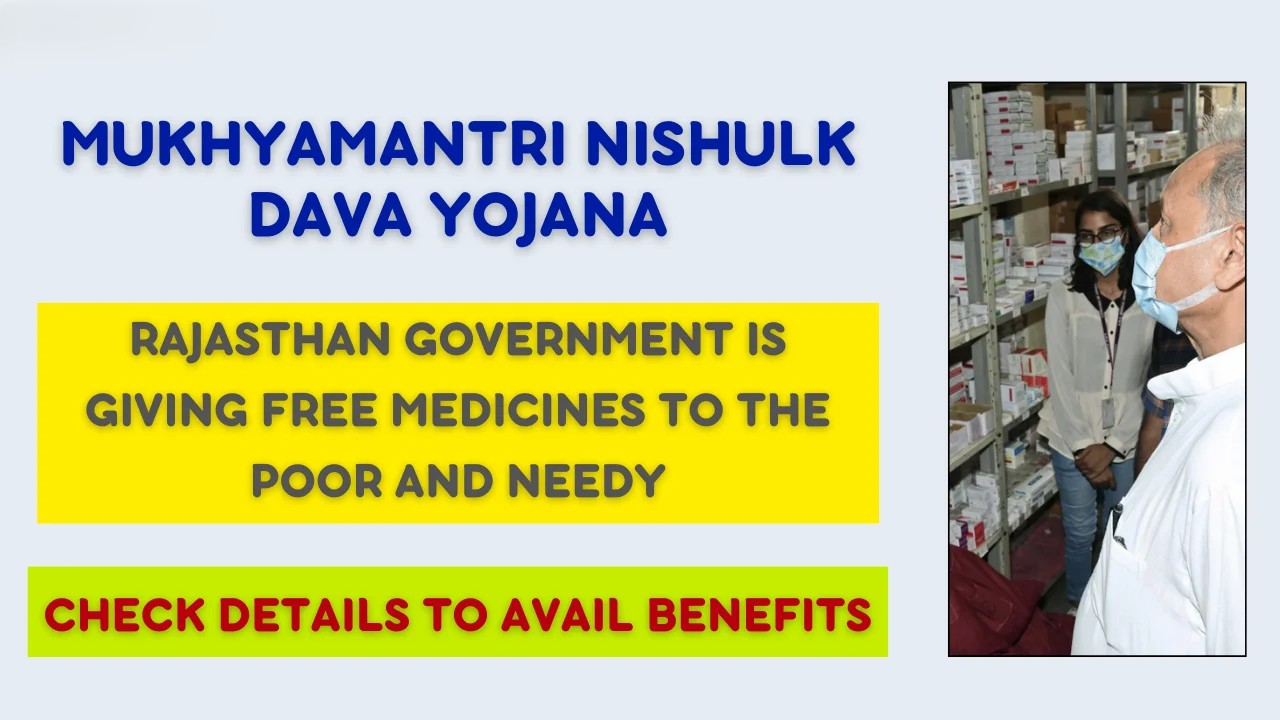
The Mukhyamantri Nishulk Dava Yojana is one of Rajasthan’s most impactful public welfare programmes aimed at providing free essential medicines to all patients visiting government hospitals. Launched on 02 October 2011, the scheme seeks to remove financial barriers in accessing healthcare and ensure that quality medicines are available without cost to every citizen, especially the poor and vulnerable. The initiative is implemented through the Rajasthan Medical Services Corporation, which manages procurement, storage, distribution, and supply of medicines across the state.
Over the years, the scheme has grown significantly, expanding its coverage from district-level drug warehouses to sub-stores, community health centres, primary health centres, satellite hospitals, and medical college hospitals. To modernize the system and ensure transparency, the government introduced e-Aushadhi, a robust web-based drug inventory management system that digitizes every stage of drug supply — from procurement to dispensing.
Objectives of the Scheme
The Mukhyamantri Nishulk Dava Yojana has been designed with several core objectives:
- Ensuring that all citizens receive essential medicines free of cost at government healthcare facilities.
- Reducing out-of-pocket expenditure on medicines, which forms a significant portion of medical spending.
- Improving the overall health of the population by ensuring regular availability of quality drugs.
- Establishing a transparent and efficient drug procurement and distribution system.
- Preventing stock shortages and wastage through modern inventory management.
- Strengthening primary, secondary, and tertiary healthcare infrastructure.
- Promoting wider use of government health facilities by providing essential medicines at no cost.
Key Features of the Scheme
The initiative includes several important features that make it one of the most successful public healthcare schemes in India:
- All commonly used essential drugs are provided free of cost to all patients.
- Medicines are dispensed at dedicated Drug Distribution Centres (DDCs) located in government hospitals.
- A user-friendly digital software, e-Aushadhi, manages real-time drug inventory across all centres.
- Drug procurement is centralized to ensure quality, standardization, and cost efficiency.
- Patients receive a printed drug issue slip (nok fooj.k i=), which includes details of medicines and market value.
- Free drug distribution covers medical colleges, district hospitals, sub-district hospitals, CHCs, PHCs, dispensaries, and satellite hospitals.
- The system incorporates barcoding, batch tracking, and expiry management.
- Digital records of patients and dispensed drugs are maintained for better monitoring.
Scope and Coverage of the Scheme
The scheme covers:
- Medical College Hospitals
- District Hospitals
- Sub-District Hospitals
- Satellite Hospitals
- Community Health Centres (CHCs)
- Primary Health Centres (PHCs)
- Urban Dispensaries
Drug Distribution Centres (DDCs) and sub-stores at all these levels are progressively being digitized through e-Aushadhi.
Implementation Through e-Aushadhi
e-Aushadhi is a web-based application designed to handle drug supply chain management efficiently. It ensures transparency, reduces leakages, and improves accessibility.
Key Functions of e-Aushadhi
- Digital management of inward and outward drug movement
- Real-time stock availability monitoring
- Generation of drug issue vouchers and receipts
- Batch-wise tracking with expiry alerts
- Patient profiling
- Automatic consumption reports
- Facilitates auditing and inspections
- Integration with hospital sub-stores and main warehouses
The shift from manual to digital inventory management has drastically improved efficiency and minimized human errors.
Phase-wise Project Implementation
Phase I: Computerization of District Drug Warehouses
The first phase successfully computerized all District Drug Warehouses across Rajasthan. e-Aushadhi was implemented in each warehouse, ensuring the digital management of drug stocks at the district level.
Phase II: Computerization of Sub-Stores and DDCs
In the second phase, the government expanded the project to include sub-stores and Drug Distribution Centres at lower-tier health institutions. This includes:
- Medical College Hospitals
- District Hospitals
- Sub-District Hospitals
- Satellite Hospitals
- CHCs, PHCs, and urban dispensaries
A dedicated monitoring cell will also be set up at each warehouse for training, supervision, and compliance.
Computerization Requirements
To enable full-scale implementation, each centre requires:
- Computer systems
- Printers
- UPS/Inverters
- Internet connectivity
- Basic computer-trained personnel
The “man-with-machine” model ensures that trained staff operate every digital unit.
Financial Estimates
One-time Establishment Cost per Unit
Each digital unit requires equipment such as UPS, internet facility, electrical fittings, display boards, and miscellaneous expenses. These are arranged through RMRS at the hospital level.
Recurring Monthly Expenditure
Monthly costs include:
- Staff remuneration
- Printer stationery
- Internet charges
- Software support
- Contingency expenses
This ensures seamless functioning of the digital system at all DDCs and sub-stores.
Innovative Patient-Friendly Drug Issue Slip
Under the scheme, every patient receives a printed drug slip stating:
- Drug names
- Batch numbers
- Expiry dates
- Quantity issued
- Per-unit rate
- Total value based on quantity
- Market price for comparison
A clear note is printed on every slip:
“These medicines are issued free of cost under the Mukhyamantri Nishulk Dava Yojana.”
This improves transparency and ensures patients value the free medicines being provided.
Benefits of Mukhyamantri Nishulk Dava Yojana
The scheme brings multiple benefits to the people of Rajasthan:
- Eliminates the burden of buying essential medicines
- Improves healthcare outcomes
- Increases trust in government healthcare institutions
- Enhances patient satisfaction
- Reduces out-of-pocket expenditure significantly
- Ensures quality-assured medicines through centralized procurement
- Prevents malpractices and ensures transparent drug distribution
- Digital monitoring reduces corruption and misuse
Impact on Healthcare Delivery
Since its launch, the scheme has transformed healthcare access across Rajasthan:
- Increased patient footfall in government hospitals
- Reduced financial stress on poor households
- Improved availability of life-saving drugs
- Boosted efficiency through digital inventory management
- Strengthened public health infrastructure statewide
The scheme is often cited as a national model for free medicine distribution and digital drug management.