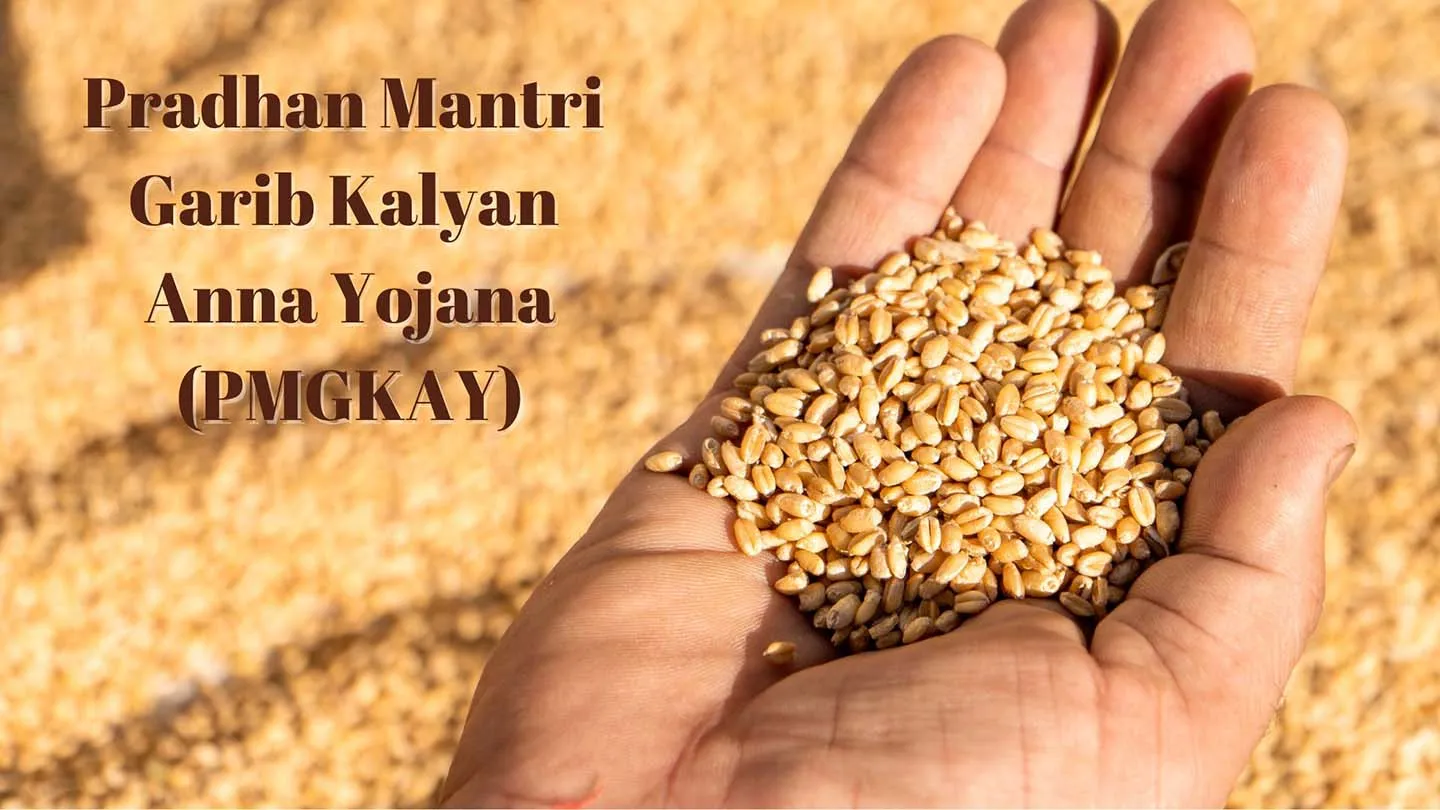
Pradhan Mantri Garib Kalyan Anna Yojana (PM-GKAY) is one of India’s largest food security initiatives launched by the Ministry of Finance under the Atmanirbhar Bharat program. Designed to protect the poor, migrant workers, and economically vulnerable families, the scheme ensures free distribution of essential food grains during times of hardship, particularly during the COVID-19 pandemic. Implemented through the Public Distribution System (PDS), PM-GKAY supplements the existing National Food Security Act (NFSA) ration by providing additional free food grains to all eligible households, ensuring no family is left without food support during crises.
Objectives of the Scheme
- To ensure food security for poor and vulnerable families during economic or national emergencies.
- To provide additional free food grains over and above existing NFSA entitlements.
- To support migrant workers, daily wage earners, and low-income households affected by lockdowns or loss of livelihood.
- To reduce financial burden on families by supplying free ration during difficult times.
- To improve transparency and accessibility through Aadhaar-based authentication and PDS reforms.
- To enable nationwide portability through the One Nation One Ration Card (ONORC) system for seamless ration access anywhere in India.
Key Features of the Scheme
- Free 5 kg of food grains per person or per household (depending on state rules).
- Allocation includes rice or wheat, depending on the state’s consumption patterns.
- Additional to subsidized NFSA ration, at ₹2–₹3 per kg.
- No separate registration needed—all NFSA beneficiaries are automatically included.
- Aadhaar-enabled authentication at Fair Price Shops for transparency.
- Nationwide coverage through Public Distribution System (PDS).
- Full portability across India through the One Nation One Ration Card (ONORC) program.
- Special allocation such as ₹80,000 crore food subsidy during Phase VI.
- Ensures immediate relief for families in rural and urban areas facing financial stress.
Scholarship Amount / Benefit Amount (Converted as per Food Scheme)
Since this scheme provides food grains instead of monetary scholarships, the “Scholarship Amount” section is converted to “Benefit Amount Provided”:
Benefit Amount / Entitlement Under PM-GKAY
- 5 kg of food grains (rice or wheat) per person or per household, completely free of cost.
- This is in addition to the existing NFSA allocation of 5 kg subsidized grains at ₹2–₹3 per kg.
- Wheat is provided to:
• Punjab, Haryana, Rajasthan, Chandigarh, Delhi, Gujarat - Rice is provided to:
• All other States and Union Territories
Eligibility Criteria
To receive benefits under PM-GKAY, beneficiaries must fall under categories defined by the National Food Security Act (NFSA):
1. Antyodaya Anna Yojana (AAY) Households
Families considered the poorest of the poor, including:
• Households headed by widows
• Terminally ill persons
• Persons with disabilities
• Elderly individuals above 60 years with no income source
• Single men/women with no social support
• Primitive tribal households
2. Priority Household (PHH) Families
Identified by State Governments based on income and vulnerability factors, such as:
• Landless laborers
• Marginal farmers
• Rural artisans (potters, blacksmiths, tanners, weavers, carpenters)
• Slum dwellers
• Daily wage workers like coolies, porters, fruit sellers, rickshaw pullers
• Rag pickers, cobblers, destitute individuals
• Below Poverty Line HIV-positive families
3. Possession of NFSA Ration Card
A valid AAY or PHH ration card is mandatory.
Reservation Policy (Target Groups)
This scheme does not follow traditional reservation categories like SC/ST/OBC.
Instead, it targets specific vulnerable groups, which include:
Target Groups under PM-GKAY
- Antyodaya Anna Yojana (AAY) families
- Priority Households (PHH)
- Below Poverty Line (BPL) families
- Primitive tribal groups
- Migrant workers
- Daily wage earners
- Slum dwellers
- Families of HIV-positive persons
- Elderly and destitute individuals
- Workers in informal sectors such as street vendors and artisans
This ensures ration support reaches the most economically backward families in both rural and urban regions.
Distribution of Scholarships (Converted to: Distribution of Food Grains)
PM-GKAY does not distribute scholarships; it distributes food grains.
The distribution mechanism is as follows:
Distribution Process
- Central Allocation:
Government allocates food grains to States/UTs through the Food Corporation of India (FCI). - State Distribution:
Food grains are delivered to state-level godowns and then to Fair Price Shops (FPS). - PDS Delivery:
Benefits are distributed through ration shops after Aadhaar or ration card authentication. - Wheat and Rice Allocation:
- Wheat: Punjab, Haryana, Rajasthan, Chandigarh, Delhi, Gujarat
- Rice: Remaining states and UTs
- Portability via ONORC:
Beneficiaries can collect ration anywhere in the country, helpful for migrant workers and traveling laborers.
Application Process (Step-by-Step)
No separate application is required for PM-GKAY because all NFSA ration cardholders are automatically eligible.
However, beneficiaries must follow these steps to receive the free food grains:
Step 1: Visit the Nearest Fair Price Shop (FPS)
Go to your local government ration shop (PDS outlet).
Step 2: Provide Ration Card or Aadhaar Number
Share either of the following with the shop dealer:
• Ration Card Number
• Aadhaar Number
Step 3: Complete Biometric Authentication
Verification is done using:
• Fingerprint scan
• Iris scan
This ensures correct and fair distribution.
Step 4: Receive the Allocated Free Food Grains
Once verified, the beneficiary receives:
• 5 kg of rice or wheat free of cost
(Quantity varies by state rules—per person or per household.)
Step 5: Collect Receipt (if provided)
Some states issue a receipt for transparency purposes.
Documents Required
- Ration Card
- Aadhaar Card (preferably linked to the ration card)