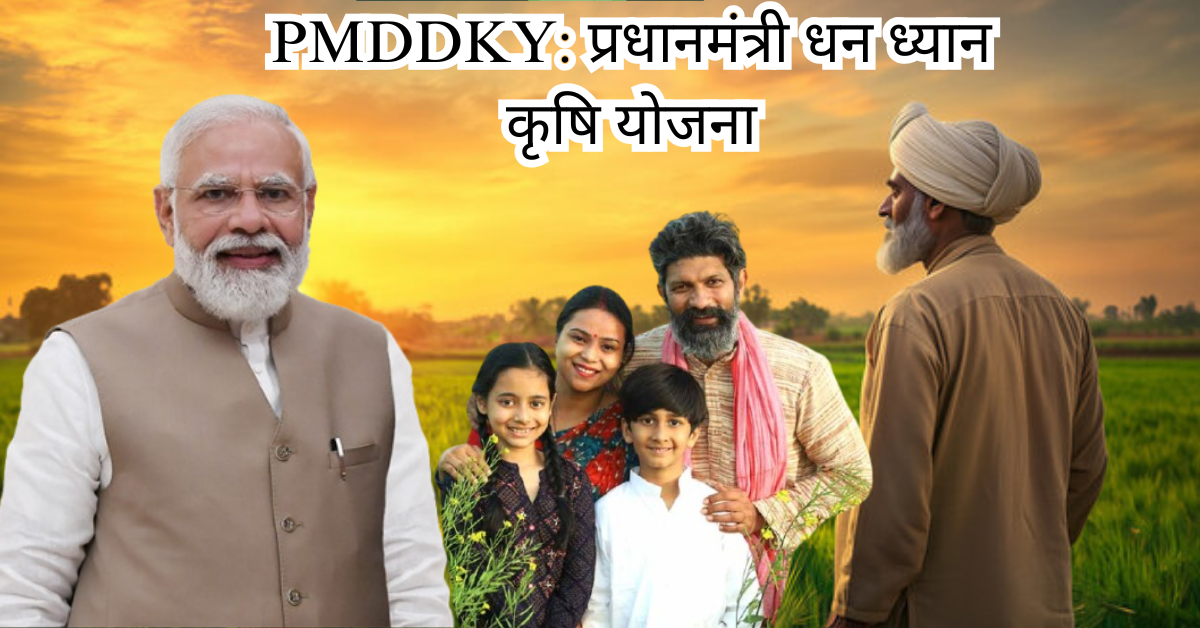
India’s agriculture sector forms the backbone of the rural economy, yet many regions continue to struggle with low productivity, insufficient irrigation, limited access to credit, and inadequate post-harvest infrastructure. To address these long-standing challenges, the Government of India announced a major agricultural transformation initiative in the Union Budget 2025—Prime Minister Dhan-Dhaanya Krishi Yojana (PMDDKY).
This ambitious programme aims to unlock the agricultural potential of 100 low-productivity districts, enhance farmers’ income, and establish a strong foundation for sustainable and climate-resilient farming.
What Is PM Dhan-Dhaanya Krishi Yojana?
Inspired by the success of the Aspirational Districts Programme, PMDDKY will be implemented through a collaborative framework between the Central Government, State Governments, and various Ministries. The initiative will leverage convergence of multiple existing agricultural schemes to maximize efficiency and create impact at the grassroots.
District Selection Criteria
The 100 districts selected under PMDDKY are based on three measurable indicators:
- Low agricultural productivity
- Moderate crop intensity
- Below-average agricultural credit availability
Every state will have at least one district participating in the mission, ensuring inclusive national coverage.
Key Objectives of PMDDKY
The programme targets holistic agricultural development through six primary goals:
1. Boost Agricultural Productivity
- Improve access to high-quality seeds and balanced fertilizers
- Promote mechanization and modern farming techniques
- Encourage digital agriculture and precision farming
2. Promote Crop Diversification
- Move farmers away from monoculture cropping
- Introduce high-value crops like horticulture, spices, and medicinal plants
- Provide price support to encourage diversification
3. Encourage Sustainable Agriculture
- Expand organic and natural farming
- Adopt Integrated Pest Management (IPM) and Integrated Nutrient Management (INM)
- Promote water-efficient cropping and climate-resilient seed varieties
4. Strengthen Post-Harvest Storage and Processing
- Establish cold storage, silos, warehouses, and pack houses at district and panchayat levels
- Promote local-level value addition and food processing
- Encourage Farmer Producer Organizations (FPOs) and direct market access platforms
5. Improve Irrigation Infrastructure
- Expand drip and sprinkler irrigation
- Revive traditional water bodies
- Integrate Command Area Development projects
6. Facilitate Access to Credit
- Expand Kisan Credit Card (KCC) coverage, including allied sectors like fisheries and animal husbandry
- Support long-term agricultural loans and infrastructure finance
- Promote Agriculture Infrastructure Fund (AIF) utilization
Implementation and Governance Framework
A robust multi-tier governance mechanism will ensure smooth execution:
| Level | Committee Lead | Role |
|---|---|---|
| District | District Collector | Plan creation & implementation |
| State | Chief Secretary | Review and monitor |
| National (Executive) | Union Minister of Agriculture | Policy direction |
| National (Monitoring) | Secretary, Agriculture & Farmers Welfare | Evaluation & progress tracking |
A baseline survey will serve as the foundation for planning, covering areas such as soil health, irrigation capacity, seed availability, storage infrastructure, credit flow, and crop potential.
Convergence of Major Government Schemes
PMDDKY will integrate multiple flagship schemes, including:
- PM-Kisan
- PM Fasal Bima Yojana
- PM Kisan Sampada Yojana
- Pradhan Mantri Krishi Sinchayee Yojana
- Mission for Integrated Development of Horticulture
- PM Formalization of Micro Food Processing Enterprises
- Agriculture Infrastructure Fund
- NREGA (for infrastructure support)
States are also encouraged to merge their regional agricultural schemes for more impactful outcomes.
Technology, Training, and Farmer Empowerment
The programme includes:
- A dedicated mobile app for scheme accessibility in regional languages
- District-level agricultural events at the start of each season
- Technical support from ICAR, Krishi Vigyan Kendras, and Agricultural Universities
- Skill development through Skill India and NRLM
Monitoring and Reporting
Progress will be monitored through a real-time dashboard developed by NITI Aayog, similar to the Aspirational Districts Programme. Districts will be ranked monthly based on outcomes and Key Performance Indicators (KPIs).
Expected Outcomes
Once fully implemented, PM Dhan-Dhaanya Krishi Yojana aims to achieve:
- Significant increase in agricultural productivity
- Higher crop diversification and crop intensity
- Sustainable and climate-resilient farming systems
- Strong post-harvest and value-addition ecosystem
- Improved irrigation and water-use efficiency
- Wider access to formal agricultural credit
Ultimately, the initiative focuses on boosting farmers’ income, reducing regional agricultural disparity, and ensuring national food security.