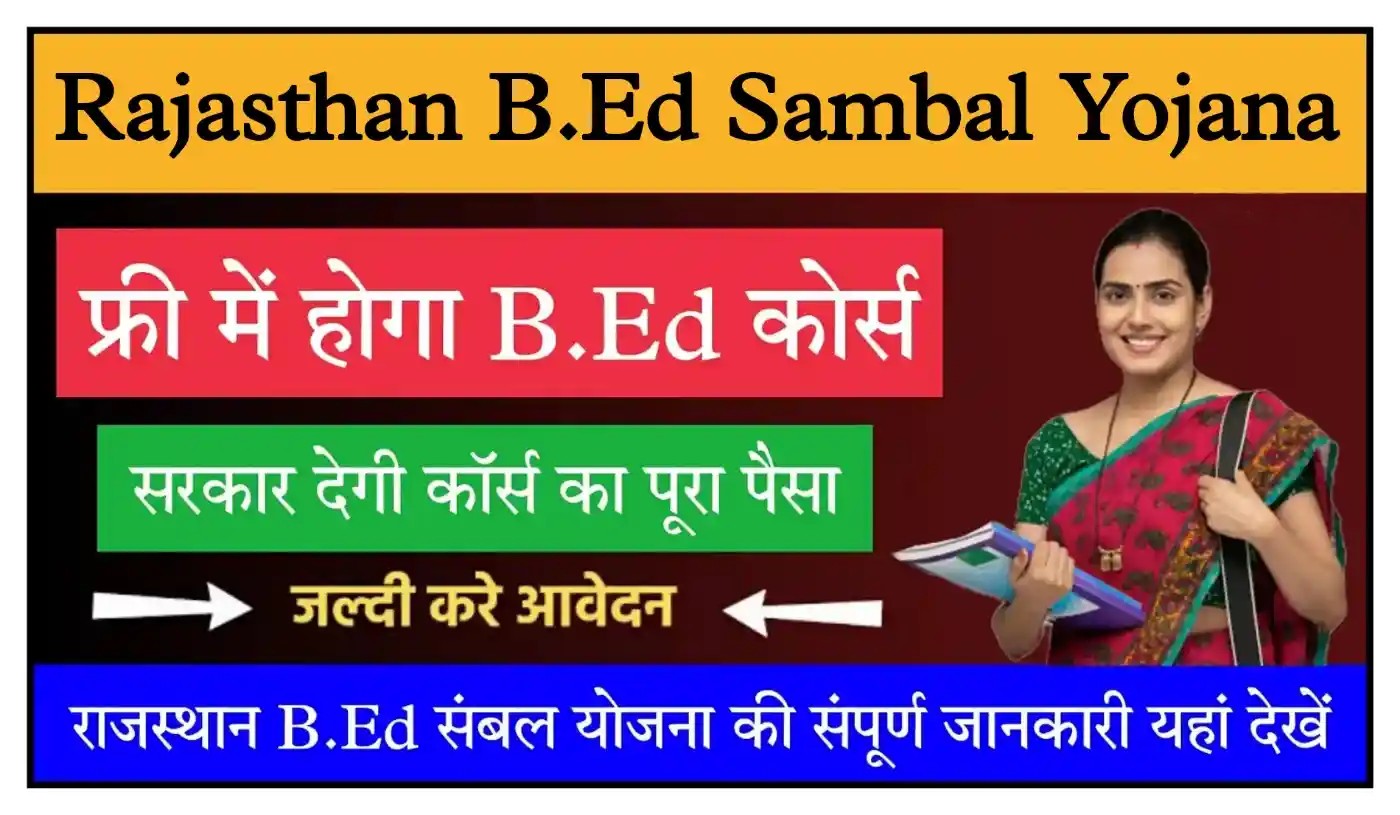
Education plays a critical role in empowering women and ensuring their socio-economic development. Recognizing the need to support widowed or abandoned women who aspire to become teachers, the Rajasthan Government launched the Widow/Divorced Chief Minister (B.Ed) Sambal Scheme. This scheme reimburses the course fees for B.Ed programs in government and recognized private teacher training institutions for eligible women. By providing financial assistance and educational opportunities, the scheme ensures that widows and abandoned women are not deprived of professional growth and economic independence due to marital circumstances. The initiative is part of the government’s broader efforts to promote women’s empowerment through higher education and skill development, enabling them to contribute meaningfully to society while achieving personal and professional stability.
Important Dates
- Application Start Date: 23rd September 2025
- Application End Date: 31st October 2025
These dates are applicable for the academic session 2025–26, and candidates must submit their applications within this timeframe to be considered for benefits under the scheme.
Objectives of the Scheme
The Widow/Divorced Chief Minister (B.Ed) Sambal Scheme was introduced with clear objectives to enhance educational opportunities for widowed or abandoned women in Rajasthan. The main objectives are:
- Provide Financial Support: To reimburse the course fees for women enrolling in B.Ed programs, reducing financial barriers to professional education.
- Empower Women Professionally: To encourage widows and abandoned women to pursue careers in teaching by supporting their B.Ed studies.
- Promote Regular Attendance and Academic Excellence: By linking benefits to regular attendance (minimum 75%), the scheme encourages disciplined and committed learning.
- Ensure Socio-Economic Independence: By equipping women with a professional qualification, the scheme helps them achieve economic stability and self-reliance.
- Facilitate Access to Higher Education: The scheme provides an avenue for widowed or abandoned women to access teacher training programs without financial stress.
Key Features of the Scheme
The key features of the Widow/Divorced Chief Minister (B.Ed) Sambal Scheme make it an essential program for the targeted beneficiaries. These include:
- Fee Reimbursement: The scheme reimburses the entire B.Ed course fee for eligible women, making professional education affordable.
- Targeted Beneficiaries: Only widowed or abandoned women enrolling in B.Ed programs in Rajasthan are eligible. Women who have already obtained a B.Ed degree are not eligible.
- Regular Attendance Requirement: Beneficiaries must maintain at least 75% attendance in their respective institutions to receive benefits.
- No Dual Benefits: Women receiving benefits from any other scholarship or financial assistance scheme are not eligible under this program.
- Statewide Coverage: The scheme applies to all government and recognized private B.Ed institutions across Rajasthan.
- Supportive Application Process: The application process is entirely online, with necessary guidance provided by college authorities to ensure successful submission.
- Documentation Requirement: Applicants must provide documents such as divorce certificates, death certificates, Aadhaar card, domicile certificate, fee receipt, and educational qualification proof.
Scholarship Amount
The Widow/Divorced Chief Minister (B.Ed) Sambal Scheme provides full fee reimbursement for eligible candidates. For the academic session 2025–26, the amount reimbursed per candidate is ₹17,880, covering the entire course fee for the B.Ed program.
This financial support ensures that eligible women can pursue teacher training without worrying about tuition costs, enabling them to focus on their studies and professional development.
Eligibility Criteria
Eligibility under this scheme is strictly defined to ensure that the benefits reach the intended beneficiaries. The criteria are as follows:
- Residency: The applicant must be a native of Rajasthan.
- Marital Status: The scheme is specifically for widowed or abandoned women.
- Widows must submit the death certificate of their husband.
- Abandoned/divorced women must submit a divorce certificate issued by a competent court or Kazi, notarized along with affidavits from two reputable community members.
- Educational Enrollment: Only women enrolled as regular students in a B.Ed training program at government or recognized private institutions in Rajasthan are eligible.
- Previous Qualification: Women who have already obtained a B.Ed degree are not eligible for this scheme.
- Attendance Requirement: Applicants must have 75% or more attendance in their respective institutions.
- Non-Overlap: Beneficiaries should not be receiving any other scholarship or financial assistance from the government or any equivalent program.
By enforcing these criteria, the scheme ensures that the benefits are targeted to women who are genuinely in need and committed to completing their B.Ed program.
Reservation Policy
This scheme does not have a caste-based reservation policy as it focuses specifically on widowed and abandoned women pursuing B.Ed courses. The primary aim is to provide educational assistance based on marital and socio-economic status, rather than community or caste.
Distribution of Scholarships
The distribution process under the Widow/Divorced Chief Minister (B.Ed) Sambal Scheme ensures transparency and merit-based allocation:
- Verification by College Authorities:
- The principal of the teacher training institution verifies the applicant’s documents, attendance record, and eligibility.
- Verified applications are forwarded online to the district nodal officer.
- District Nodal Officer Verification:
- The nodal officer reviews the submitted applications and ensures all documents are complete and authentic.
- After verification, the applications are forwarded to the Commissioner, College Education Department, Rajasthan for approval.
- Fee Reimbursement:
- After final approval, the fee amount (₹17,880) is reimbursed directly to the applicant’s bank account.
- The reimbursement ensures that the candidate can continue her education without financial burden.
- Monitoring Attendance and Academic Performance:
- Colleges are responsible for monitoring attendance.
- Any student dropping out or failing to meet the attendance requirement becomes ineligible for benefits.
This multi-level verification process guarantees that only deserving beneficiaries receive support and prevents misuse of funds.
Application Process (Step by Step)
The application process for the Widow/Divorced Chief Minister (B.Ed) Sambal Scheme is online and straightforward. The step-by-step process is:
Step 1: Registration
- Candidates must visit the official portal of the scheme.
- If not already registered, applicants need to register by providing personal details and creating login credentials.
Step 2: Login
- Registered users log in using SSOID and password.
Step 3: Filling the Application Form
- Complete the online application form with accurate personal, academic, and financial details.
- Ensure marital status, B.Ed enrollment, and attendance information is correctly mentioned.
Step 4: Upload Required Documents
Applicants must upload self-attested copies of the following documents:
- Aadhaar Card Copy
- Address Proof Copy
- Bank Passbook Copy
- Divorce Certificate Copy (for abandoned/divorced applicants)
- Death Certificate Copy (for widows)
- Domicile Certificate Copy
- Educational Qualification Certificate/Marksheet
- Fee Receipt for B.Ed Admission
- Jan Aadhaar/Bhamashah Card Copy
Step 5: Submission
- After completing the form and uploading documents, submit the application.
- College authorities verify and forward the application to the district nodal officer online.
Step 6: Final Verification and Reimbursement
- The district nodal officer and Commissioner, College Education Department, verify the application.
- Upon approval, the fee reimbursement of ₹17,880 is credited to the applicant’s bank account.
Required Documents
To ensure smooth processing of applications, candidates must provide the following mandatory documents:
- Aadhaar Card – Proof of identity.
- Address Proof – Residential proof of Rajasthan origin.
- Bank Passbook Copy – For receiving reimbursement.
- Death Certificate (Widows) – Proof of husband’s demise.
- Divorce Certificate (Abandoned/Divorced) – Issued by competent court or Kazi, notarized, and attested by community members.
- Domicile Certificate – Proof of state residency.
- Education Qualification Marksheet/Certificate – Verification of eligibility for B.Ed course.
- Fee Receipt – Evidence of course fee payment.
- Jan Aadhaar/Bhamashah Card – Additional identity and residential verification.
All documents must be self-attested and authentic, as incomplete or incorrect submissions may result in rejection of the application.
Monitoring and Compliance
The scheme emphasizes strict monitoring to ensure compliance:
- College principals are responsible for verifying attendance and forwarding applications.
- The district nodal officer conducts detailed verification before online forwarding.
- Any discrepancies in attendance, documentation, or eligibility will result in rejection.
- Beneficiaries must adhere to scheme guidelines throughout the course.
This ensures that the support reaches the deserving candidates and helps maintain transparency and accountability in the process.
Impact of the Scheme
The Widow/Divorced Chief Minister (B.Ed) Sambal Scheme has significant social and educational implications:
- Empowering Women: By supporting widows and abandoned women in acquiring professional qualifications, the scheme promotes self-reliance and confidence.
- Encouraging Higher Education: Financial assistance removes barriers to pursuing teacher training, ensuring women can continue education without monetary constraints.
- Creating Career Opportunities: B.Ed graduates become eligible for teaching jobs, enhancing economic independence.
- Promoting Social Inclusion: The scheme ensures that women in difficult marital circumstances are not left behind in educational and professional development.
By combining financial support with eligibility verification and a merit-based online system, the scheme has positively impacted the lives of many widowed and abandoned women across Rajasthan.